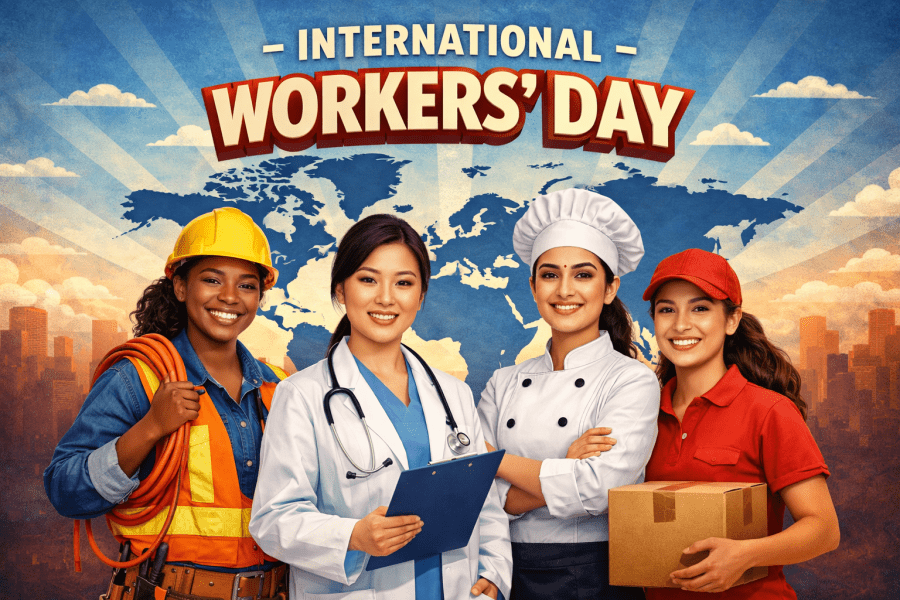
1 May – International Workers’ Day
The Work We Recognise — and the Work We Rely On
Work is often understood through what can be measured — hours logged, salaries earned, roles defined by contracts and titles. It is framed as something visible, structured, and economically valued. Yet this understanding only tells part of the story.
Alongside formal employment exists another layer of labour, one that is essential to the functioning of households, communities, and relationships, but which is rarely acknowledged in the same way. This includes caregiving, emotional support, household management, and the quiet, ongoing effort required to sustain others. It is work that does not end at the close of a working day, and it is work that is often expected rather than recognised.
International Workers’ Day provides an opportunity to reflect not only on employment rights and conditions, but also on the forms of labour that remain largely invisible, despite their significance.
Invisible Labour and Unequal Burdens
For many women, particularly those from Black and minoritised communities, the boundaries between paid and unpaid work are not clearly defined. Responsibilities extend beyond employment into domestic and relational spaces, where expectations can be deeply ingrained and rarely questioned.
This labour is not occasional or supplementary. It is continuous, often shaped by cultural norms, family structures, and social expectations that position women as primary caregivers and emotional anchors. Over time, the accumulation of these responsibilities can create a significant imbalance, one that limits rest, restricts personal autonomy, and reduces the capacity to make independent choices.
What makes this imbalance particularly difficult to address is that it is frequently normalised. Because it is expected, it is not always recognised as labour. Because it is not recognised, it is rarely challenged.
When Labour Becomes a Form of Control
In some contexts, the dynamics surrounding work extend beyond expectation into control. Economic abuse can manifest in ways that are not immediately visible, particularly within close relationships, where financial dependence is reinforced and autonomy is restricted.
This may involve limiting access to employment, controlling income, or creating conditions in which a woman’s labour is relied upon but not valued. The expectation to contribute — whether through unpaid domestic work or emotional support — can exist alongside a lack of financial independence, leaving little room for personal agency.
These experiences are often difficult to articulate, in part because they do not always align with common perceptions of abuse. However, they have a direct impact on safety, stability, and the ability to make decisions about one’s own life.
The Role of Culture, Identity, and Expectation
The experience of labour, and the expectations attached to it, are shaped by a range of intersecting factors. Culture, migration, race, and gender all influence how work is distributed, how it is perceived, and how it is valued.
For some women, there is an additional layer of expectation — to maintain family structures, to uphold cultural norms, and to prioritise collective needs over individual wellbeing. In these contexts, the line between responsibility and obligation can become blurred, making it more difficult to question or redefine these roles.
Speaking about imbalance or unfairness can carry its own risks, particularly where there is a strong emphasis on loyalty, respect, or maintaining harmony. As a result, the pressures associated with invisible labour often remain unspoken, even when they are deeply felt.

Rethinking What Counts as Work
Recognising invisible labour requires a shift in perspective. It involves moving beyond narrow definitions of productivity and acknowledging the value of care, support, and emotional effort as integral forms of work.
This is not simply about recognition in principle, but about understanding the impact that unacknowledged labour can have over time. When work is expected but not valued, it shapes how individuals see themselves, how their contributions are perceived, and what opportunities are available to them.
Creating space for these conversations allows for a more honest understanding of labour, one that reflects lived experience rather than idealised assumptions.
Towards Fairness, Recognition, and Choice
At Anah Project, we see how labour, in its many forms, is connected to autonomy, safety, and identity. We see how expectations can limit opportunities, and how the absence of recognition can affect both wellbeing and self-worth.
International Workers’ Day is not only about recognising workers in formal roles. It is also about acknowledging those whose labour remains unseen, and whose contributions continue without the protections or validation they deserve.
Moving towards fairness requires more than awareness. It requires a willingness to question long-standing assumptions about who does what, and why. It requires recognising that choice — the ability to decide how one’s time, energy, and skills are used — is central to both dignity and independence.
In recognising all forms of labour, we begin to create space for that choice to exist.